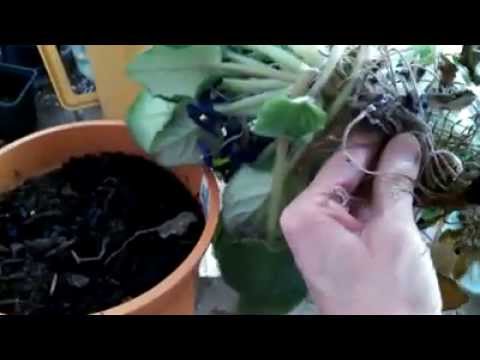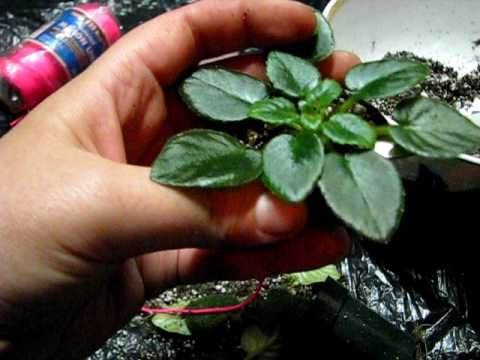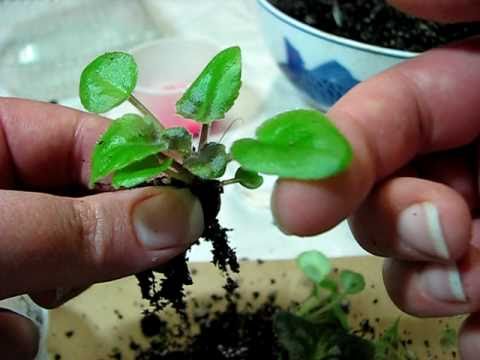
Violets 101 image designating the African Violet Society of America is providing the information
Graphic Join African Violet Society of America

BASICS FOR BEGINNERS

Three methods to water violets:
  1. Top water by pouring room temperature water into the top of the pot (under the leaves) and turning the pot as you pour. Pour enough water that it runs through and drains out the bottom of the pot into a saucer. Wait 10-30 minutes and empty the saucer.
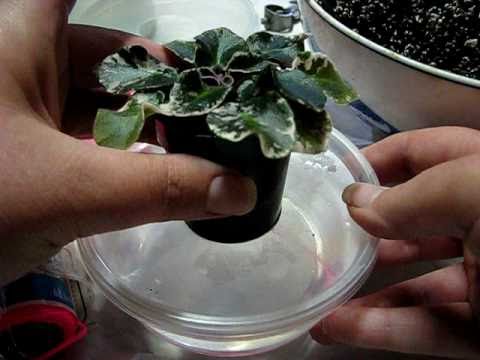
  2. Bottom water by filling a saucer with room temperature water and allow the violet to stand in the water for up to 30 minutes while the water is absorbed. Drain off the excess water.
  3. Constant watering methods like wick-watering, capillary mat watering, or specialized pots which self water are also effective. These require specialized potting mix and procedures to make the process work correctly.

If humidity is moderate (20-50%,) expect to water once a week, or when the pot feels very light when lifting it. Growers in more humid climates may need to water less often. Those who live in dry arid climates may need to water more often.

The easiest way to kill your violet is to overwater it.

Read More About Watering African Violets

Getting the proper light will result in more flowers

In nature, the wild African violet species grow under a deep forest canopy near the equator. It is much like light coming in through windows draped with sheer curtains.

When choosing a good window for your violets, consider these questions:

  1. How warm does the space get during the hottest or coldest part of a day? Violets prefer a temperature range of 65 to 80° F (18 to 27° C.)
  2. Does the sun shine directly into the window? The intensity of the full sun is often too strong for African violets, and too hot as well.
  3. How close will the violets be to the windows? The most successful window growers position their violets within 24 inches (60 cm) of the window.

Watch your violet to see how it reacts to the light. If the leaves develop long stems and reach up, it wants brighter light. If the leaves lose color (bleach) the light is probably too intense.

Those who lack adequate window space often choose artificial light such as LED or fluorescent.

Read About Lighting Options

TIP #1  POTS

Grow your violet in a pot that is smaller than the spread of the leaves. Many growers find that violets bloom best when the diameter of the plant is three times wider than the pot.

TIP #2  FERTILIZER

Fertilize your violet with every watering if you want it to thrive and to bloom well. A balanced fertilizer for houseplants works well for many growers. If the package gives directions for monthly use, cut the fertilizer to one-fourth strength for weekly use. Weekly – weakly produces good results. Avoid over-fertilizing.

TIP #3  POTTING MIX

Violets have very fine roots and are very sensitive to root rot if they do not have air pockets in the potting mix. For this reason, many growers choose a peat-based potting mix that is 50% coarse perlite. It is rare to be able to buy such a porous mix in a store. To make your own, mix one-part potting mix with one-part coarse perlite. When potting plants, be careful to pile the mix loosely into the pot and do not pack the soil down around the roots.

Read More About Pots ~ Fertilizer ~ Potting Mix 

Frequently Asked Questions

FAQs

If you don’t find your answer here …

QUESTION: What is the Latin name for African violets?

Answer: The botanical name for African violets is “Saintpaulia.” It is in the family of Gesneriaceae, which also includes such plants as Gloxinia, Streptocarpus, Aeschynanthus and Episcia.

QUESTION: We’ve been having a discussion in a group about whether it is possible to definitely “name” an unknown violet based on characteristics. I’ve maintained that you cannot, because plants may bloom differently under different growing conditions. Even if you make the best educated guess possible, it is just that, a guess. I am positive I’ve seen an AVSA position on the issue of NOIDs (plants with no ID) in the magazine, but can’t recall where or what exactly was said. Does AVSA have a position on the matter? I’d love to share that with our group.

Answer: It is almost impossible to accurately identify an African violet that doesn’t have a name tag or other type of identification (a NOID, or a plant with no ID). The African Violet Master List of Species and Cultivars (AVML) and the First Class computer program lists more than 16,000 different named African violets and their descriptions. Depending on your NOID, you could find a few dozen that match the characteristics. You might even be able to narrow it down to four or five. But then you would need to choose one of them, and it would be highly unlikely that you would choose the correct name. Besides that, the AVML has less than half of the named African violets. Even if you found a photo that matched your plant exactly, the odds are great that it is not your plant. So many African violets look the same, and they all grow differently under different growing conditions. It is definitely a mistake to try to identify a NOID in this manner. There are already far too many misidentified African violets out there now. (Just ask anyone who has done classification and entries at an African violet show.) Please don’t add to the problem.

QUESTION: What is a NOID or No-id?

Answer: This term is commonly applied in social media to describe a violet which has been separated from its identity and name. It now cannot be identified and has no-id. Once lost, it is extremely difficult to restore the proper name. Many violets sold in large retail stores will be NOIDS primarily because unlabeled hybrids are easier to produce and may be sold at a more competitive price. NOIDs may not be entered into AVSA shows, but otherwise they are enjoyable violets to grow. As violet collectors come to understand the value of the hybrid name, they also become more careful to buy violets which are properly labeled and to maintaiin that label when they repot or propagate the plant.

Updated 07-2020

QUESTION: I’ve had my African violet for about two-and-a-half years. It’s growing great, but I have yet to see a single bloom. is there something I’m doing wrong?

Answer: African violets need several things to bloom well.

  • It must receive adequate light. African violets prefer to be within 12 inches of a bright window. If windows aren’t available, fluorescent light or LED lights may be used to supplement. Depending on the lighting product, violets should be positioned 10-30 inches away from the light unit, and the light should be turned on for 6-12 hours a day. Violets receiving adequate light grow with a flat horizontal wheel of leaves. If it isn’t getting enough light, the leaves will usually reach upward and have long petioles (leaf stems).
  • It must be fertilized regularly with a balanced mix for African violets. There are many good brands. Many growers opt to use products at 1/8-1/4 strength every week.
  • African violets bloom best when in small pots, ideally only one-third the diameter of their leaf span. A plant that measures nine inches across should be in a three-inch pot.
  • African violets bloom best when the roots are well-developed. The best roots form in very porous potting mix which is kept evenly moist at all times–never saturated and never bone dry. We recommend a quality mix combined half and half with an equal amount of coarse perlite (tropical regions may need a greater ratio of coarse perlite).
  • If the air is very dry, the flower buds may be drying off before they are even visible. Humidity levels of 40% are ideal. Check also to see if a vent might be blowing dry air across the surface of the plant.
  • Some African violets become vegetative, meaning they are so comfortable that they only grow leaves. To convert them to being reproductive, you must give them a little scare. Repotting is one method. It also works to tap the pot firmly on a hard surface or squeeze the pot to create a minor earthquake. This seems to awaken the survival-of-the-species instinct, and your violet will often set buds.
  • Some varieties are shy bloomers. If you have tried all of these techniques and it still does not bloom, try again with a different variety that may be more suited to your conditions.

QUESTION: I have an African violet chimera that used to “bloom true,” but now it is not. Do you have any reason why and will it bloom true again?

Answer: Chimera hybrids contain two separate sets of DNA, which makes them an unusual type of African violet which may only be reproduced by suckers or by blossom-stem propagation. Chimera African violets are  prone to sport which means that they mutate easily back to a hybrid with only one of the sets of DNA. Stress factors such as uneven cultural conditions, age, or even electrical currents seem to result in sporting. Occasionally, just a single leaf on the chimera plant will sport and throw a solid blossom, while other leaves will continue to bloom true. When that happens, it is wise to take a blossom stem to propagate so that you can keep the original chimera traits. If it has been blooming incorrectly for several months, from all parts of the plant, it is safe to assume that the chimera trait is lost, and it will not be likely to reappear.

QUESTION: Once a flower or cluster of flowers is spent, do you trim it back just below the flower or do you trim it back to the base of the plant at the dirt. The original crown of flowers on my plants are all almost done. I see new buds emerging but not to the extent as the first time. Is this usually what happens?

Answer: Trim off the individual flowers as they fade, and when the entire cluster is gone, remove the flower stem by rocking it from side to side until it comes loose from the main stem. This trimming has the effect of increasing future blooming, so it is important to keep up with it.

QUESTION: I have several African violets. They are all in the self-watering pots. One is a mature plant that has been blooming regularly. Recently, two of my African violets have begun to get buds as if they were going to bloom, but before they actually bloom they wilt and die. The leaves look really healthy. I fertilize when I water, and they get natural, indirect sunlight 8-10 hours a day. Can you tell me what I am doing wrong?

Answer: I can make a few suggestions as to why your buds are not opening.

  • Low humidity can be a factor. African violets thrive on 40-60% humidity, and when the air around the African violet is dryer than that, the buds can fail. This is especially bad if there is a dry air draft blowing across the surface of the plants.
  • Similarly buds may collapse if the African violet potting mix gets too dry. If you have been allowing the self-watering pots to go dry, this could be the problem. Once potting mix goes dry, it can be difficult to get it moist again because peat moss tends to shed water. In self-watering pots, especially the kind that have no drainage, it can be especially hard to restore the balance in the soil moisture. Repotting is often the only answer.
  • Powdery mildew is a fungal disease and looks like white powder. It can appear on many parts of the plant. If it should happen to grow on bud stems, it could cause the buds to fail. A fungicide may be needed to control it.
  • Cyclamen mites are a pest that feeds on the newest growth of the plant, which includes bud stems. If the center part of the plant seems to be twisting, gnarling, or stunting, or if the buds stems are growing in a similarly distorted way, you may have an infestation of mites.

Updated 07-2020

QUESTION: What diseases are common to African violets?

Answer: Common diseases are:

  • Powdery mildew which appears as a white powder on leaves and flowers.
  • Root or crown rot which occurs when pathogens (such as pythium or phytophthora) are present in wet or damp conditions.
  • Impatiens Necrotic Spot Virus (INSV) which is spread by thrips and is incurable.

Growers have reported a number of other diseases, but in most cases accurate diagnosis requires a plant pathologist who can prescribe a specific treatment. Your state Agricultural Extension Service often provides this service.

QUESTION: What is the best way to avoid powdery mildew in my violets?

Answer: Powdery mildew thrives in humid conditions, especially where daytime and nighttime temperatures vary by more than 15 degrees. Plants which are too close together may block air movement and increase problems with humid pockets of air. Many growers find it helps to run a fan on low 24 hours a day. A dehumidifier also may be helpful.

When powdery mildew is present in early stages, it may be removed by simple washing (blot leaves dry after.) When the disease becomes persistent, many growers report excellent results using Spectracide Immunox.

QUESTION: What are the symptoms of root rot?

Answer: For most growers, the first symptoms will be soft outside leaves, limp as though they aren’t getting water. When this happens and soil is moist, it may help to allow the violet to dry out while sitting on an absorbent towel or pile of paper. If roots are darkened and matted, root rot disease is likely present, and trimming the roots and repotting must be done quickly.

QUESTION: What is stunt disease?

Answer: Stunt is actually just a symptom of a disease, pest, or cultural condition which has stopped the growth of the crown at its center. The most common disease causing stunt is INSV. The most common pest causing stunt is cyclamen mite. The most common cultural conditions causing stunt include toxic levels of micronutrients (often the result of low pH) and pollution from natural gas leaks.

QUESTION: How do I recognize and diagnose INSV?

Answer: Impatiens Necrotic Spot Virus is inoculated into plants by a vector–most commonly Western Flower Thrips. When they are carrying the disease, they transmit the disease by scraping the plant surface with their mouth part. Individual cells in small areas of the plant are infected first and then spread. The classic symptom is a target shaped mark with one or more yellow circles on a leaf. Growers have also reported odd growth or puckers, stunted centers, and a general lack of vitality. The disease may be diagnosed definitively only with an Agdia ELISA test.

Read Sandy Skalski’s article here: “What You Need to Know NOW About Impatiens Necrotic Spot Virus

FAQ – Fertilizer

QUESTION: What is the best fertilizer to use on African violets?

Answer: The answer is ever-changing, because fertilizers seem to come and go frequently. The best fertilizer for you will depend on the source of the water you are using and what is or isn’t in the water as well as the pH of your water. The temperature of your growing area may also affect your choice.

Almost all fertilizers offer the basic three macro-nutrients” of nitrogen, phosphorus and potassium which are needed in ample supply for healthy plant growth. A few also include the “macros” of calcium and magnesium. Since these two latter “macros” are found in many city water supplies, most growers will get enough calcium and magnesium from their water. If you use rain, distilled or reverse osmosis water, be aware that you need a fertilizer that contains both, or you will need a supplement (commonly called Cal/Mag) to supply them. In the past, many growers chose fertilizers with a high “middle number” (phosphorus) because it promoted blooming. There may be some value in boosting phosphorus briefly if you are a show grower, but be careful because too much can damage foliage and hurt the plant. READ UP.DOWN.ALL AROUND. UNDERSTANDING THE THREE BASIC PLANT NUTRIENTS

Many fertilizer brands also have and list “micro-nutrients” which are needed for healthy growth, but in very small amounts. Not all brands list the “micros,” but they can be very important. Sulfur, for example, tends to lower pH in the root zone. If you have problems with high pH (over 7), a fertilizer with sulfur will help you control your problems and bring your pH into a more desirable range of 6-7.  But, if your pH tends to become too acid (below 6), then sulfur will make the problem worse.  If you use well water or live in mining regions where your water supply may carry high amounts of specific minerals, it is possible for your violets to show symptoms of toxic levels of a micro-nutrient. This may cause irreversible stunting of center growth which looks very much like the violet has mutated to a miniaturized version of the original. It helps to know what your local water supply contains and to choose your fertilizer accordingly.

Choosing a fertilizer according to the source of the nutrients is also wise. Fertilizers listing their source as urea nitrogen are often the cheapest and also the least desirable. If your growing area is frequently colder than 70 degrees Fahrenheit, a fertilizer made from urea is more likely to result in ammonium toxicity. This is because the mycorrhizae (soil bacteria which process nitrogen into a usable form for roots to absorb) are inactive at cold temperatures–ammonium toxicity becomes more likely if fertilizer is sourced from urea.  Fertilizers using ammoniacal nitrogen or nitrate are a little more expensive but are generally better quality and less likely to pose problems.

It is often wise to ask others in your area which fertilizer works best for them. Some growers like to rotate and use different fertilizers during the year, using balanced formulas during times when more growth is desired and high phosphorus formulas when preparing for show.

Fertilizers currently (2020) being mentioned by many growers in social media (especially to use with rain, distilled or reverse osmosis water) include either DynaGro Grow 7-9-5  or Feed Me MSU fertilizer for African violets (from repotme.com). Also recommended is Better Gro Orchid Plus 20-14-13 without urea, which is also preferred by many growers of other Gesneriads. Jack’s Classic formulations generally lack sulphur and may be useful for growers with acid growing conditions. As always, read and follow package directions (do not exceed recommendations) for best results.

QUESTION: The only peat moss I have found in bags also has fertilizer in it. Can I still use fertilizer in the water every time I water or will this be too much? 2) The fertilizer I have is 12-14-12 and says to use 1/2 tsp per gallon of water. Should I dilute it even more then? 3) I haven’t found any peat moss without fertilizer unless you can use the kind you buy in bales that you would use in the garden. If you use this kind I thought I read somewhere about having to sterilize it. Is this true and how would I go about it?

Answer: If you have no choice except for the fertilizer-charged potting mix, then you do not want to fertilize for about three months. This is why we dislike potting mixes with a fertilizer charge–you really don’t know at what point you should begin fertilizing.

If the fertilizer recommends this rate for once-a-month fertilizing and you are going to use it weekly, you should dilute it to no more than an 1/8 tsp per gallon. If this is their recommendation for weekly watering, I would still dilute to 1/4 tsp and then watch. If you see fading vigor, then a bit more might be good. However, if you see yellow spots or edges around the perimeter of the older leaves, you are over-fertilizing, and you need to cut back the rate of feeding.

If you choose a bale that has no tears or cuts, the peat should be safe to use. Rather than sterilize the potting mix, the goal is only to pasteurize it which is done by heating the damp mix just to 180°F and holding that temperature for thirty minutes. Sterilizing it (at a higher temp) would destroy the beneficial bacteria that enable the roots to absorb nutrients.

Updated 07-2020

QUESTION: What are some good resources for learning about growing violets?

Answer: Here are some recommendations:

  • YOU CAN Grow African Violets: The Official Guide Authorized by the African Violet Society of America, Inc., written by Kent and Joyce Stork is available at the AVSA website.
  • Growing to Show by Pauline Bartholomew, which focuses on competitive growing but has many excellent tips for everyday growing too.
  • The AVSA Handbook for Growers, Exhibitors and Judges is also very useful for even beginning growers with history, cultural information, and what constitutes a well-grown African violet.
  • The African Violet Magazine is an excellent source of growing information. The Index of Articles is designed to help you locate articles, but the articles are not on the AVSA website. You may purchase individual copies of previous magazines with articles that interest you, providing that there are still copies of the issues in stock.

QUESTION: Is it true that African violets only require minimum care to survive?

Answer: If surviving is all you want, African violets can survive under very difficult circumstances such as droughts, but African violets will not survive in conditions that are too wet since they are very susceptible to root and crown rot diseases.

QUESTION: I have a 29-gallon fish tank with 2 strip lights. I would like to grow African violets in it.  I think I may need a glass cover in order to keep some humidity in the tank. Has anyone tried this before?

Answer: Large fish tanks can be used for African violets, but it does require some specific adjustments.

  1. The plants should be positioned about twelve inches below the light tubes, which should be turned on about twelve hours a day. They can be slightly further away if the lights run longer (up to 15 hours a day). Miniature or semiminiature violets need to be closer yet (8″) from the lights for twelve hours a day to get them to bloom freely.
  2. The strip lights need to be either LED or fluorescent tubes, using a combination of cool and warm white.
  3. The African violets should be grown in their own individual pots rather than planted into a common garden.
  4. Typically there will be enough humidity without a cover, providing that you are watering on a regular basis. Watering may be the difficult part, since it isn’t easy to get access to plants that are set down in a deep aquarium.
  5. The most serious problem I foresee is that you may have problems with fungal diseases, most especially powdery mildew, which tends to thrive in warm humid areas that have little air circulation. Keeping a small fan running inside may help prevent problems.

You may also have some problems with temperatures that are a little warm for African violets, which prefer to be grown at about 72 degrees with a slight drop at night. When grown warmer, the growth will be softer, the leaves tend to be less compact, and the colors of the blossoms will be less intense.

QUESTION: I am looking for some information about making a greenhouse for African violets, can you help with that? For example, in general which material I should choose, glass or wood,.. or what kind of insulation is appropriate?

Answer: I usually do not recommend greenhouse growing of African violets. One of the prime pests that bother African violets is thrips, and it is virtually impossible to keep thrips out of greenhouses. Violets grow better when the temperatures are maintained rather rigidly between 65 and 80°F. This is very difficult to do in a greenhouse setting. When the temperatures vary more than that, the violets will get a rougher look. Nearly all violets grown for competition are done under artificial lights where air temperatures can be better controlled.

Greenhouse growing might be your choice if you plan to grow a tremendous number (1,000’s) of violets and want to be able to diversify and grow other crops too.

Updated 07-2020

QUESTION: How do I prune (an African violet)?

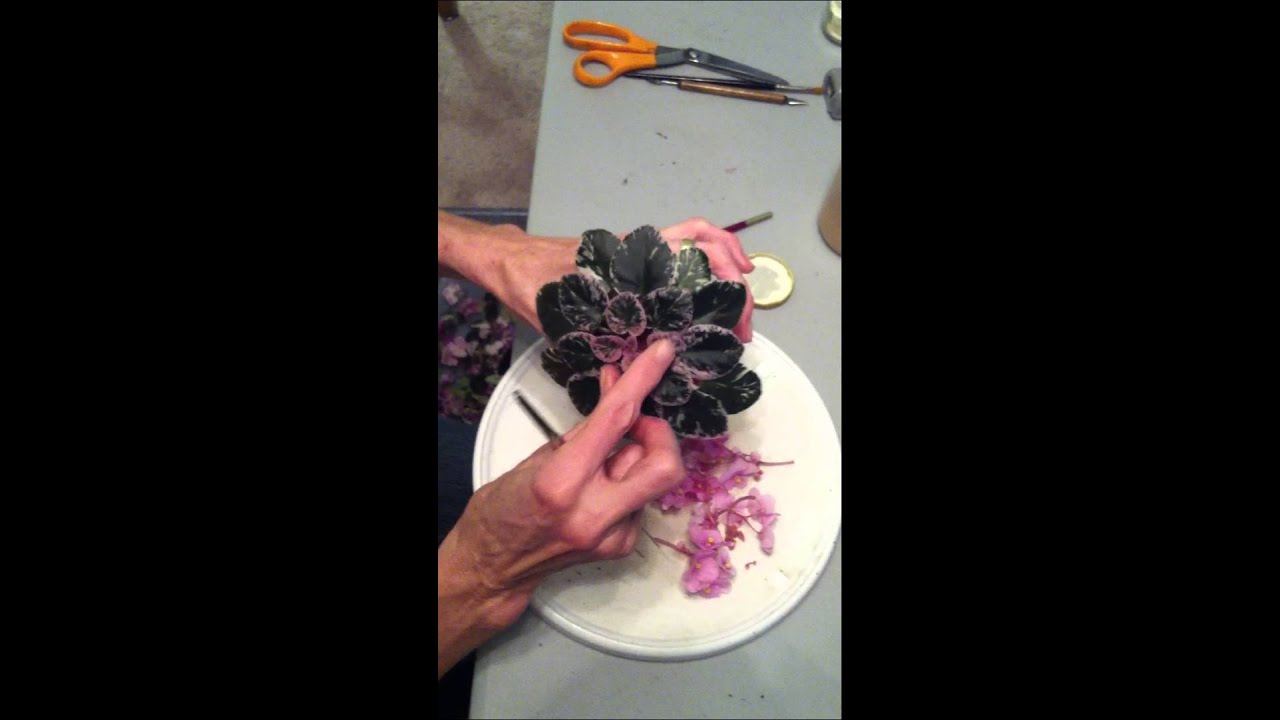
Answer: Pruning in African violets is not done in the same way, generally, as it is for other plants. It is more common that violet growers groom plants by removing any individual flowers as they fade and entire blossom stems when the last flower is fading. Grooming also includes removing leaves which are damaged and any that are fading on the lower rows. Both blossom stems and leaves are easily removed by rocking them from side to side until they pull loose from the plant.

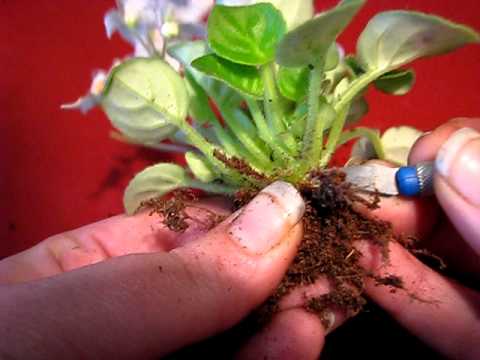
Pruning techniques would include removing secondary crowns (suckers) either to propagate or to discard. If a secondary crown has been allowed to grow to a mature size, then the plant needs to be divided by cutting between the two crowns and potting each into its own pot. Pruning also occurs when shaping trailers to achieve a beautiful form. In some cases, the center leaves of a crown are removed or pruned, for example, to cause a trailer to develop additional crowns thus giving it a better overall form or to force a chimera plant to sucker freely (since leaf propagation is unreliable.)

QUESTION: Please tell me how to clean the leaves of my African violets and what to use.

Answer:  If it is only a tiny bit of debris, it may be removed by blowing. For more general cleaning, many growers brush debris away with soft brushes such as those used for makeup or painting. Strokes should always be toward the tip of the leaf.

Violets may also be washed at the faucet using a gentle flow of mildly warm (tepid) water. If residue is stubborn, some growers spray mist the leaves with a solution of 1-2 drops of water in a quart bottle of warm water.  After all leaves have been rinsed, you should blot excess water off the leaves (especially any in the center) with a soft sponge, paper towel or cloth. Keep the plant out of sunlight until thoroughly dry.

Persistent cat hair or drywall dust may be more difficult to remove. Several growers in social media have reported using lint-remover rollers with replaceable sticky paper. They gently roll across the leaf from stem toward the tip. They say that no damage to the leaf seems to develop afterward.

Updated 07-2020

QUESTION: How much humidity do African violets need?

Answer: African violets can tolerate humidity as low as 10%, but that is so dry that tiny buds rarely survive to open as flowers. To encourage flower development, it is best to aim for 30-60%. Fungus diseases often thrive in higher humidity and may be almost uncontrollable. Oddly, when a violet crown has no roots, we recommend enclosing it in a Ziploc bag or in a dome with 100% humidity for a month or two. That high level of humidity restricts evaporation from the leaves and allows excellent conditions for roots to form. That treatment is not recommended in warm tropical climates where disease spores may be more prevalent.

QUESTION: What is the range of humidity the plant is use to and what temperature range? I am putting some in a vivarium with the humidity around 80-90% plus the amount of water needed. I mist once or twice a day.

Answer: If the humidity range is actually in the 80-90% range, you may not need to add much water at all. African violets in nature commonly grow in a range of 30-60% humidity with temperatures ranging from the low 60’s to the 80’s Fahrenheit. At high humidity, fungus diseases are more likely to thrive, especially in an enclosed environment. I would suggest trying just one African violet in the vivarium to see how it does for a few months before you try more.

Updated 07-2020

QUESTION: Is there a reason that many types of African violets have fuzzy leaves? Does it increase the surface area to improve photosynthesis?

Answer: There are several advantages that are credited to African violet’s fuzzy leaves.

  • The nap (or the direction that the hairs lean) leans toward the tip of the leaf, away from the center of the plant, so that raindrops tend to run off of the plant instead of into the crown where the moisture could lead to rot.
  • The hairs provide a sort of air blanket against any changes in air temperature, which are common in nature. Violets thrive at 72 degrees Fahrenheit with a range of five degrees on either side of that.
  • Larger chewing pests, like beetles, are held above the actual plant tissue by the hairs. When they try to feed on violets, they get an undesirable mouthful of fuzz and soon move on to other easier food sources.

The entire Gesneriad family (which includes African violets, but also Episcia, Gloxinia, Achimenes, Streptocarpus, etc.) is characterized by some degree of fuzz on the leaf. All photosynthesis goes on in the surface cells of the leaf itself, so the hairs do not impact photosynthesis.

QUESTION: What are girl leaves?

Answer: In African violets, the term “girl” has nothing to do with gender. It originated  when an early hybrid named “Blue Boy” produced a sport with unusual foliage, and the cultivar was named “Blue Girl.” Any cultivar since with the same foliage is considered a “girl.”

Girl foliage is the result of a genetic fault which allows the petiole (leaf stem) to grow into the leaf blade. This creates a pale green or somewhat pink splotch at the base of the leaf which contrasts with the deeper green of the leaf. Depending on how far the stem tissue grows into the leaf, the leaf becomes more ruffled and often unmanageable as it tries to cope with the extra cells. Many girl leaves are also lobed or heavily scalloped. Girl leaves often have short petioles which may cause an exaggerated compact or tight growth pattern, especially if grown in cool locations.

Updated 07-2020

QUESTION: Because I’m completely inexperienced with artificial lighting, I need someone to point me in the direction of an appropriate lighting source to fit my needs.

Answer: Today’s lighting choices give you lots of options using either LED or fluorescent lighting. If energy efficiency is a priority, then LED lights are a good choice.

• Adhesive LED ribbon lights may be added to the underside of almost any shelf. It takes several rows of the ribbon lights to provide adequate lighting. It may be helpful to combine both warm white strips and daylight strips for the best color spectrum.
• You might also consider an LED fixture, but avoid the intense lights sold for growing plants (they are often too intense for violets and may be unpleasant to be around.)
• Fluorescent lights have worked well for many years. The fixtures tend to be available only in 24,” 48,” or 96″ tubes. A fluorescent fixture using T8 or T12 tubes will work best for most growers. For the best spectrum of color with fluorescents, growers often choose one “cool white” tube and one “warm white” tube.

Each grower should make adjustments after observing how the violets are reacting. In most cases, leaves reaching up with long petioles (leaf stems) are not getting enough light. If leaves are reaching up with short petioles and compact growth, the light may be too intense or the spectrum may not be well-balanced. In an ideal light situation, violets grow with a flat horizontal rosette of leaves and flower frequently.

QUESTION: What distance should mature standard African violets be from fluorescent tubes? I am using 2 tube fixtures: 48 inch 40 watt T12 Gro-lux wide-spectrum. What distance for leaf cuttings? And for leaf cuttings with plantlets? Some of my plantlets I have separated are now a bronze color instead of light green color, what caused this? Will they green up again? If you could answer all of these questions I’d really appreciate it.

Answer: Mature well-rooted plants should be positioned about 12 inches below the tubes (distance between the tube and the foliage), and the lights should be on for approximately 12 hours a day. If the tubes are very new, the time may need to be reduced by as much as 4 hours (to only 8 hours a day) and gradually increased by fifteen to thirty minutes a week until you reach 12 hours. Generally, if the leaves are reaching upward, there isn’t enough light. If the leaves are bleaching (bronze or white-green color), there is too much light. Plants that are rooting (such as recently divided clumps and propagated leaf cuttings) often seem to need less light and can usually be set around the edges of the shelf rather than right under the middle where the light is the most intense. Usually leaves will green up again after bleaching, provided that the light is reduced and that they are receiving a balanced fertilizer on a regular basis.

See Lighting Options used by a variety of respected growers.

Updated 07-2020

QUESTION: On the membership information page two types of membership are listed; individual and associate. What is the difference?

Answer: Individual Membership is for those who wish to receive the African Violet Magazine. Associate membership is for those who live at the same address as an AVSA member (who receives the magazine) and who wish to have a membership number so that they may exhibit in AVSA shows or participate in AVSA activities as a member. Associates do not receive a copy of the magazine.

QUESTION: How does the AVSA Digital Membership work?

Answer: Those selecting Digital Membership will receive access to the magazine on the Members Area of the Society website. The cost of Digital Membership is the same regardless of your location. The digital pdf has links throughout. For example, within the magazine, readers may click to jump from the Table of Contents or Index of Advertisers to the article, photo, or ad you wish to see. In addition, ads are linked to the advertisers’ websites. Readers are able to zoom in or out to view content. Digital devices must have an Adobe PDF reader to open the attachment.  Each digital issue is viewable online by the first day of its issue month.

Updated 07-2020

QUESTION: I don’t want bug problems! Is there a safe preventative?

Answer: For a preventative, I would recommend a Neem oil product such as AzaMax (which requires less shaking to keep the oil in suspension.) Neem is reasonably effective in discouraging insects. It prevents the thrips from reproducing, and makes the plants an unpleasant place to lay eggs. It will not spot if you use a fine mist and distilled water.

QUESTION: I think I have Thrips, now what?

Answer:  Adult thrips are slender and tiny, at about 0.039 (1 mm) inches long. Their colors can be yellow, tan, brown or black. They have narrow, fringed wings and feed mostly on plants by puncturing and sucking up the contents. While they can be seen with the naked eye, use a magnifying glass to get a better look. Thrips can also spread Impatiens Necrotic Spot Virus (INSV). Read an article on “How to eliminate Thrips“.

QUESTION:  There are little white/gray bugs in the bottom of the wick-watered African violet plants. The bugs move pretty fast. They are so small they could be on other plants?

Answer: These fast-moving pests are probably springtails. It is their unusual tail which allows them to move so quickly. They live in, lay eggs in, and feed on decayed matter in the potting mix and thrive where there is standing water. They depend on high humidity and constant dampness. They do not cause damage to the violets unless you happen to be a hybridizer who might have some tiny little seedlings sprouting. Spring tails are mostly just unsightly. They are fairly easy to control by limiting moist conditions. Repotting into fresh potting mix (and discarding the old into a closed container) also helps. You might also try drenching the soil with a solution of Safer Insecticidal soap three times over a period of three weeks, following package directions.

QUESTION: I have black bugs that look like gnats. How can I get rid of these pests?

Answer: If they fly and appear also to be moving in the soil, then they probably are fungus gnats, shore flies, or fruit flies. Fruit flies are rather common in the fall when we tend to bring in garden produce to finish ripening on the counter top. They can be very hard to eradicate until a hard frost, unless you keep the tomatoes, etc., outside. All of these gnat pests depend on a moist place to nest and lay eggs and decayed matter on which to feed. In most cases they do no harm, but they are a nuisance. Safer Insecticidal Soap may be helpful as a drench. The soapy substance dries the skin of the insect and causes death. In addition, be sure to wipe off the outside of the pots and the surfaces around the plant to get rid of any decayed matter (peat moss, dead leaves, etc.). If there is standing water anywhere in the area, it should be covered or removed.  Some growers have discovered that “mosquito bits” added to potting mix or to reservoirs are effective.

QUESTION: I may have a cyclamen mite problem. I was told at an African violet show that I should just start leaf cuttings and discard the plant. He said the mites only stay in the smallest crown leaves, and I should be safe taking cuttings from the outer (older) leaves. Some of my plants are rare. I would be sad to throw them out. I have about fifty plants, and I do not want to lose all of them over a few problem plants. Suggestions?

Answer:  Mites are only able to feed on the tenderest cells of the plant, which includes the new leaves in the center of the violet, the blossom stems, and sometimes slightly wilted older leaves when the plant is dry. You may treat the plants for mites, but if they are well established, it will take at least a year for the violets to grow out of the damage. Disposal is often the wiser choice and the one I recommend. You certainly may take leaves to propagate. When you do so, rinse them under a gentle stream of tepid water and then use the techniques described in the article on propagating leaves on this website. While the leaf is rooting, it will be very turgid (and too hard to feed on), and any mites still present will starve before the new offspring are big enough to be a food source. Be sure to keep the leaves enclosed until the plantlets are large enough to transplant (about 6 months). Also be aware that geraniums, begonias and ivies (as well as other tender plants) are frequent hosts of cyclamen mites. If they are in the growing area, you would be wise to treat or discard them as well.

QUESTION: I am still having problems with tight centers and poor plant condition generally with mites as the seemingly popular cause. My question is on Cyclamen mites in particular. Are these pests associated only with Cyclamen? I have never seen Cyclamen on the island, and as I am on a rural section, there can’t be any (even if they exist) within half mile of my plants at least. Are there any other plants that the Cyclamen mites inhabit, or are they just a general pest?

Answer: Cyclamen mites became known first in cyclamen plants but definitely infest other plants as well. Hosts may include: ivy, snapdragon, chrysanthemum, larkspur, geranium, fuchsia, begonia, petunia, daisy, and azalea.

QUESTION: If plants are treated by the grower with a toxic substance, would a plant that I purchase remain toxic to pets and, if so, for how long? I have cats and would like to know if they could get sick if they should nibble a leaf from a plant that was treated.

Answer: There isn’t any firm rule on how long a toxic substance might last. . .it depends on the substance. The only way to know the danger is to find out exactly what had been used and what the long-term danger is. Most of the time, there will be no danger at all. If you are concerned, repot into fresh soil and place it in an enclosure for one to two months while chemicals break down.

Updated 12-2022

QUESTION: I have several self-watering pots that worked fine for a while, but when I repotted the violets, I cleaned the pot with water/bleach, and now they won’t work. Is there anything I can do to make the pots work again?

Answer: Soaking it in a vinegar solution for several days to dissolve the mineral and then in distilled water for several days to remove the acidity should help. You can test to see if the pots are working by laying a dry sheet of paper towel inside the empty pots which have been set into filled reservoir pots. The toweling should be moist in a matter of hours. Sandpaper may help break through a crust of build-up. Sometimes these pots just harden up and never recover. It may help to use water which is half tap water and half distilled water to reduce the amount of mineral deposit. Ultimately, you may be happier trying another of the various self-watering pots now on the market.

QUESTION:  I planted my African violet in a “self-watering” pot. Would this work? It seems that leaves are getting droopy.

Answer: First of all, if you just transplanted your African violet in the last two to seven days, it is not uncommon for the leaves to droop, especially if you disturbed the roots. Usually the leaves rebound after a couple of days. If the violet was transplanted more than a week ago, you may have a faulty pot. Not all of the self-watering pots function properly. Feel the soil. If it feels dry, the pot may not be allowing enough water to seep into the soil. If it feels wet, then the pot may be allowing too much water to seep in, and the droopy leaves may be an indication that the roots are beginning to rot. If the pot is not functioning properly, you may need to remove the violet from the pot and start over using a different pot, following the directions found in the article on repotting on this website. If you had a wet pot, pay particular attention to step 4 in the directions which deal with how to remove rotted sections of the plant. The self-watering pots can and do work. However, I am not crazy about them because of their unreliability. There is also a problem with fertilizer salts building up in the soil as time passes, and few people realize that they must transplant once a year to get rid of the salts.

QUESTION: I was told years ago that African violets do best in plastic pots, rather than clay. Is this still true? Other than the “self-watering” is there a recommended pot? My plants, which are over 25 years old, have been doing ok in the plastic, but I always get nervous when it comes to transplanting because of the question of the size of the pot.

Answer: Most growers favor plastic pots for a number of reasons:

  1. Constant water methods (wicking or capillary matting) work best with plastic pots.
  2. Plastic pots are more easily available in smaller and more squatty sizes. Violets seem to bloom best in pots that are about one-third the diameter of the leaves, and the roots do not extend much beyond two or three inches below the surface of the soil.
  3. Plastic pots are less expensive to buy and easier to clean for reuse than clay pots.
  4. The biggest problem with plastic pots may be a sharp rim which cuts leaves resting on the rim. That may be resolved by selecting pots which were designed with rolled or blunt edges.

Now there are times when a clay pot is desirable–most especially in hot climates or greenhouse growing. The evaporation from the clay works as a cooling device and actually keeps the roots cooler. Many growers simply like the organic look of clay pots. And if you tend to overwater, clay pots evaporate excess moisture away more quickly.

QUESTION: Is it possible to plant several violets in one pot?

Answer: It is definitely possible to plant violets together in one pot, but we generally discourage you from doing so.

  • When violets are getting enough light to bloom, the leaves will grow horizontally. Planted together the leaves become tangled and out of position.
  • The roots will always be approximately 1/3 the diameter of the foliage. It is difficult to plant violets together without having a significant amount of unused and possibly saturated potting mix between the plants. This may lead to rot disease.
  • Violets tend to bloom best when the roots are confined. You might have success putting large rocks in the soil to create planting pockets throughout the pot. Another alternative would be to hide potted violets inside a larger container to give the impression that they are planted together.

It still isn’t ideal for the long run to plant violets together, but you could definitely achieve an interesting landscape by doing so for a short time just for decorative effect. Make sure that you provide adequate drainage and use a light porous potting mix.

Updated 07-2020

QUESTION: Is misting new leaf cuttings helpful?

Answer: The goal of misting is to raise humidity. Misting cuttings is often not as effective as simply enclosing the leaf in a clear plastic bag or container while it is rooting.

QUESTION: Are there any tips for rooting new cuttings?

Answer: There are several methods used to root new cuttings and all work well. Generally however, rooting will occur fastest when ambient temperatures are between 70 and 80 °F. Humidity above 50% supports the leaf until roots can form. Using a young but mature leaf from the second or third rows in the rosette will often produce roots more quickly than older leaves.

QUESTION: How do you revive limp leaves that come through the mail? I received leaves through the mail and they were very limp, so I threw them away. So is there a way?

Answer: Often the limp leaves will revive (depending on how limp they are). Some growers use a bowl of tepid water with a pinch of sugar added and lay the limp leaf in the water. Others prefer to mist the leaf with slightly warm water and place it inside a zippered plastic bag for a day or two. When a leaf begins to stiffen again, you should re-cut the stem and put it down. If any part of the leaf remains limp, simply trim it off. Cut cells from any part of the plant which are in contact with moist substrate will usually root.

QUESTION: What is better, starting leaf cuttings in water or in potting mix?

Answer: Either method works well and growers have different preferences. It is not uncommon with the soil method to wait 8 weeks or more to see growth above the soil, but roots underground should be forming. If you tug gently on the leaf and it lifts the pot, you can be certain that roots are developing. Here are a few tips for good results:

  1. Select young but mature leaves to propagate, rather than leaves which are old and may be losing color or vigor.
  2. When starting the leaves in potting mix, it is best if the potting mix is very light and fluffy with ample amounts of perlite. Using this mix allows the roots to develop more freely.
  3. Do not set the leaves into the potting mix very deeply, since the plantlets will grow from the cut end of the stem. Setting the stem in just enough to keep it in the mix makes a much shorter trip for the little plants to grow before they reach the light.
  4. It may speed up the process of propagation to trim about an inch off the tip of each “mother” leaf (using a knife to slice it off). This seems to stimulate the production of plantlets and also increases the amount of light that reaches the soil where they are forming.
  5. Enclosing rooting leaves in a clear container or Ziploc bag increases humidity and warmth which often results in faster growth.

QUESTION: Why do some leaves take longer than others to produce babies?

Answer: The speed at which offspring develop can vary widely according to variety and the vigor of the individual leaf. I find that, on average, you should expect that it takes two weeks to a month for the leaf to establish a root system. Normally, babies will begin to appear at six to eight weeks, although it can be faster on rare occasions, and it may be far longer with variegated leaves and older leaves. If the petioles were set deep into the potting mix, it may also take longer. Trimming the leaves was a good choice and should encourage a faster response. I think your purchased leaves are doing fine and appear to be right on a normal schedule.

QUESTION: I have a new plantlet that I propagated from my violet. This new one has about six leaves, but two of them are slowly turning brown around the edges and shriveling. Is this normal? What could be the cause of this? How do I keep my new baby violet growing strong?

Answer: New leaves on plantlets are very tender and vulnerable to dry air and/or direct sunlight. At this stage, many growers find that the young plants do best if kept in a terrarium-like environment where the humidity is high. Clear plastic food containers or Ziploc bags are both good choices to enclose young plants. Water the plant and allow it to stop dripping before enclosing it. Close the container, and set it out of direct sunlight but in a bright location. Your violet will probably not need additional watering as long as it is closed up in this fashion. When you believe the plant is strong enough to leave confinement (or when the plant is too big to remain there), open the container a little bit the first day and a little more the next. This allows the humidity to change gradually and will prevent wilting from the shock of sudden dry air. By the third day, the young violet will be ready to handle a more normal growing environment.

QUESTION: Where are the seeds on an African violet? Are they in the flower after it dries? I looked at all the questions on propagation, and they all involve starting form a leaf.

Answer: Seeds don’t often develop on African violets because a pollinator (human or insect) is usually required. They rarely self-pollinate. All seed develops in the ovary which is in the center of the flower below the anthers and stigma. After pollination, the ovary will swell up to about the size of a popcorn seed and look bright green in the center of the flower. The seed pod must remain on the plant for 4-6 months to ripen. There is no guarantee as to what color an African violet seedling will be–each seedling will have unique DNA. If you want exact clones then you must propagate a leaf cutting.

QUESTION: If I plant African violet(s) from seed, how long should it take to start flowering/blooming?

Answer: It always depends on your conditions, but if the potting medium is evenly moist, if there is adequate light, if the temperatures remain near 72 degrees Fahrenheit, etc., then flowering might be expected to occur about 6 to 9 months after sowing the seed.

Updated 07-2020

QUESTION: My wife has several Africa violet plants that are 20 years or older, and she is worried she will lose them by repotting and separating. How old do African violets get?

Answer: Violets may live for 50 years or more, especially if they have been repotted regularly. When a violet has gone for a long period of time without repotting, a long neck may form below the bottom row of leaves (as the oldest leaves die and are removed.) Growers have found that a “decapitation” method works very well to correct the problem quickly. This method of repotting is intimidating, but doing nothing is more likely to result in losing them.  It is necessary to be fairly aggressive in transplanting but then provide good nursing care afterward–which for African violets means being enclosed in a clear, sealed container such as a plastic bag. This video shows the process: Repotting Using Decapitation Method

QUESTION:  What time of year do you plant the African violet over into new potting medium?

Answer: African violets may be repotted into fresh potting mix at any time. Since roots develop best at slightly warmer temps, it is better to repot when the normal room temperature isn’t colder than 70 degrees Fahrenheit.

QUESTION: When should I repot?

Answer: Ideally, you should be repotting once or twice a year. Repotting during warmer times of the year is usually best for quicker rooting. You will pot up (or increase the size of the pot) when a plant is actively growing larger.  For most growers, mature (blooming) violets are usually repotted into the same size pot each time. The purpose of the regular repotting is to bury the stem that is exposed as lower leaves are lost and to freshen the potting mix which tends to become acid over time. I would repot anytime I could see the main stem (sometimes called a neck) under the bottom row of leaves. Lift the plant out of the pot and remove an inch or so from the bottom of the root ball and set the violet back down into the pot, filling in at the top with fresh potting mix. It is usually best to put the plant into a bag or high humidity area for a week or so after doing this.

QUESTION: My mom loves African violets and has always had them around her house. I have my own apartment now and would like to start my own African violets. I have already purchased two, and I read that they must be repotted immediately, but does that include the standard procedure of cutting and repotting only the crown as I have read about in other FAQs?

Answer: If you bought your violets from a retail outlet, and you hope to keep growing these violets for years, then yes, you should repot. The most thorough method to changing the mix completely is to cut off the root system and re-root the crown. Greenhouses often use a potting mix which is too dense for long-term growing but holds together well in shipping. You will have more success if you change to a more porous mix with ample amounts of perlite. As your collection grows, you will find that it is always easier to have all violets in the same potting mix and using the same watering system. READ MORE ABOUT POTTING MIX

Updated 07-2020

QUESTION: Are there any hybrids that have a true scent? Has there been any successful crossbreeds with other soil or air plants?

Answer: Some growers claim to detect a faint scent on a few rare violets. For the most part, African violets lack scent. Streptocarpus are very near relatives, and a few do have a scent, but no one has successfully crossbred Streptocarpus with Saintpaulia (the botanical name for African violets). Crossbreeding African violets with genus in the family of Gesneriaceae has never been successful as yet. Breeding within the genus of African violets (using both species and hybrids) is done regularly to produce the many hybrids that are grown today. Some have considered the possibility of genetic engineering to add scent, but to my knowledge, nothing has been accomplished to date.

Updated 07-2020

QUESTION: What are the species African violets?

Answer: The species are the plants which grew wild in the region of modern Tanzania and Kenya. Some still exist in the wild, although much of their habitat has been cleared for agriculture. Early specimens were collected as early as 1884. But in 1892, Captain Baron Walter Saint Paul collected a plant naming it “das violette Usambara” (the Usambara violet). He shared either seeds or plants with his father in Germany who brought it to the attention of the Royal Botanical Gardens at Herrenhausen in Hanover, Germany. There the plant was placed in the Gesneriad family, and given the generic name of Saintpaulia. The specific species was named ionantha (with violet-like flowers.) For more information we recommend this article “Saintpaulia – The African Violet” in the Gesneriad Reference Web

QUESTION: This is a question about the “hybrid” status of most of the African violets available today? Are the African violet hybrids today just hybrids of the species Saintpaulia ionantha, or have other species been used to add to the modern-day hybrids? Are they hybrids between the same species or of different species?

Answer: Many of the current hybrids originated from crosses made with Saintpaulia ionantha and with S. confusa (now considered to be a subspecies of S. ionantha). Recently, DNA studies established that many species previously identified as separate species were in fact all subspecies of Saintpaulia ionantha (and ionantha is now classified as a subspecies of Streptocarpus).  There are a few hybridizers, who are using the species (primarily ionantha but also others) sometimes to improve genetic lines, and sometimes to explore recessive traits. Most commonly, violet hybridizers use hybrids for both parents.

QUESTION: My house tends to be fairly cold in the winter. The room where my African violets are is usually between 60 to 65°F. Would it help them if I were to place them on warming mats (like the ones you use for starting seeds) or would that be bad for them?

Answer: Violets do best in temperatures ranging between 65 and 80° F. Warming mats are a great idea when the house is cool. The air temperature is not as important to the plant’s growth as the root temperature, and a warming mat provides just enough extra heat to keep the plant growing and thriving. It may also help to select a location nearer the ceiling (rather than near the floor), since warm air rises. Violets grown in an enclosure, such as under a dome, often enjoy temperatures 5 degrees warmer than the room temperature.

QUESTION: Will increasing temperature speed up the growth of African violets?

Answer: Cell division in most plants is faster when the temperatures are warmer. However,  as the temperatures rise above 80° F, the cells begin to break down (ultimately the foliage becomes glassy-looking and collapses).  On the other hand, cell division nearly stops below 65°F. So, while African violets will grow faster in warmer temperatures, there is a limit to how much you can do by simple warming.

Obviously, you must provide the proper soil moisture, nutrients, humidity and potting mix, but those things maintain and maximize growth without necessarily speeding it. What else can you do? There is good evidence that regular repotting and grooming by removing leaves and/or buds will stimulate more efficient growth. This increased efficiency results in faster growth and in plants which have thicker, broader, healthier leaves and more flowers.

Updated 08-2021

QUESTION: What is a trailer, and how is it different from growing other African violets?

Answer: In the wild, there were species of African violets which tended to grow with longer intervals between the leaves (unlike the rosette forms which stack leaves very tightly together on the main stalk.) These species naturally develop more crowns in the longer leaf intervals and form graceful mounds of leaves. Hybrids were developed to take advantage of this habit which are now called “trailers.” A trailing hybrid is expected to originate from a single point of growth: it is not several plants potted together. Over time, the single crown of a young plant produces new secondary crowns, often appearing in a triangular pattern so that growth at first develops in three directions from the main stalk, and then develops in multiple directions from each of those side crowns. Over time, the bulk of secondary crowns may become very large, regardless of the size of the individual leaves.  Pinching out the center leaves of a crown often results in more side crowns, and careful selection of the crowns which are allowed to grow encourages a nicer form for the overall all plant. A single rosette hybrid might have 30-50 leaves total. Trailers on the other hand may have hundreds or even thousands of leaves.

Trailers are classified by the size of the individual leaves – miniature, semiminiature, or standard.  But the leaf size does not limit the overall size of a mature plant with many crowns. Trailer hybrids vary in the way in which they grow. Some develop long runners while others remain more compact. Growers enjoy the challenge and often experiment to find what a trailing hybrid might do with careful attention to pruning and grooming. The Japanese method of growing trailers secures long runners to the surface of the soil, allowing roots to form and encouraging more crowns to develop facing upward toward the light. These trailers are grown in very broad shallow trays to accommodate their growth habit.

The hybridizer makes the decision whether a cultivar will be considered a single rosette or a trailer. This is primarily for show purposes, but the distinction serves as a good guideline to casual growers as well. A single rosette hybrid will generally bloom best if suckers are removed and the single rosette is maintained. Well-grown trailers, on the other hand, bloom just as freely with many crowns as with few.

Because trailers have more space between leaves, they seem to do well in natural light. In fact, artificial light may cause a trailer to grow too compactly and to have a less-desirable form. It is important to turn trailers to achieve even growth and flowering on all sides of the plant. Trailers may be watered similarly to single rosette hybrids, but when grown in broad shallow trays, care must be given to keep the entire tray evenly moist. Many growers opt to wick water using several wicks to supply different sections of the roots. Otherwise culture is very similar and trailers, and single rosette plants can grow happily side by side.

Updated 07-2020

QUESTION: Based on AVSA’s experience, should variegated varieties be given more or less light than solid leaved varieties? Is there anything else I should know about taking care of variegated varieties?

Answer: Light is always a factor in blooming. The problem with variegated violets is that the more variegation (non-green areas) the less chlorophyll, which means that that heavily variegated violets have less ability to produce energy than violets with all green foliage. Blooming requires energy. The amount of light that the violet receives is almost irrelevant if the violet has too little chlorophyll to process the light.

The real secret to getting variegates to bloom freely lies more in controlling the amount of variegation so that the plant is able to thrive. To control variegation requires understanding what is needed for a plant to produce chlorophyll.

  • First, it needs nitrogen and magnesium (commonly supplied in tap water), which are the essential building block for chlorophyll.
  • Second, the plant needs pH in a range of 6.0 to 7.0 which allows roots to absorb the nitrogen.
  • Third, it needs the presence of beneficial bacteria in the soil to process the nitrogen into a usable form.
  • Finally, the temperature of the potting mix must be warm enough for the bacteria to be active.

QUESTION: This is regarding mosaic variegation. I was wondering if there is any way to clarify the description regarding mosaic variegation. First, I just had someone tell me that there is actually three (3) different types of “mosaic” variegation. One is like Lilian Jarret, and the others are like Tommie Lou, and still another like a blend of the two like BMan’s Irish Red and Cajun Heritage. I have always felt the the proper description would be accurately represented by the leaves of Lilian Sparkler. I am finding that everyone is interpreting First Class as the absolute standard, and they don’t realize that the pictures in First Class are not being checked to see if they match the proper description. My first question: what is the exact description for Mosaic Variegation? My second question: Is there anyway that when the photos are submitted for First Class, that they can be checked for obvious mistakes, like showing a solid flower when it is described as a fantasy, or showing a plain leaf when it is supposed to be ruffled, or if it is described as a single pansy and the picture shows a double star. I know it would be hard to distinguish the traits that are changeable due to culture and such, but some are not even close, and if we are accepting First Class as the valid printed description, it is confusing to many to have the pictures not represent the variety accurately. I think that the pictures that don’t accurately represent the variety should be taken out of First Class, because if they don’t match the description, then they are just pretty pictures of violets not a fair representation of the variety.

QUESTION:

1) I have several variegated leaf African violets that are losing all the white or pink, and the new leaves are turning plain green. What causes this, and once this starts, is there anything I can do to stop or prevent it?

2) Do these varieties require different light & fertilizer than the plain varieties?

3) If I have to start a new leaf, do I start one of the older variegated leaves or a newer plain green one?

Answer:

1) African violets commonly lose variegation if they are getting too much nitrogen or if they are being grown in warm conditions. Variegation is a stable characteristic which will reappear when conditions change. As winter approaches, it is likely that you will see variegation developing in the center of the plants. Please note that the specific variety determines the perfect temperature for maintaining the variegation. Some hybrids variegate too much at 72°F, while others may begin growing quite green at that same temperature. A good trick is to watch the plant and move it to a higher (and warmer) location when the center leaves are more than 50% variegated and to a lower (and cooler) location when new leaves are showing little to no variegation.

2) Variegated hybrids require more perfect conditions because variegation is actually a lack of chlorophyll in the leaf. Extra nitrogen will make them greener, and little nitrogen (or an absence of magnesium usually found in tap water) will cause them to become more variegated. But, if the plant is unable to photosynthesize efficiently, you won’t get flowering. Note that growers who use rain, distilled, or reverse osmosis water are likely to have inadequate magnesium and calcium and may need to add Cal/Mag with their fertilizer. Fertilizer companies assume that the water source is tap water (which normally carries ample magnesium and calcium), and most do not add these two elements to the fertilizer composition. A simple test to see if excessive variegation is caused by a lack of magnesium is to top water with a mix of 1-2 tablespoons of Epsom salts in a gallon of water. Normally, this will improve the green color of a magnesium-deprived violet quickly – in just one or two days.

3) Because the variegation is stable, it is always best to use one of the greenest leaves for propagation. It should not be so young that it still has considerable growing to do, nor should it be an old leaf that has begun to fade. Watch the plantlets that develop closely so that they maintain their green color (by maintaining a temperature that discourages excessive variegation). In some cases, cultivars routinely produce white clones, and it is necessary to wait for the clump to mature and become more green before dividing. After they are divided from the clump, they will variegate in the same way that the parent plant did.

Updated 07-2020

QUESTION: What kind of water is best for African violets?

Answer:   In many case,s either tap or well water work fine for violets.

If problems arise which you believe are caused by bad tap or well water you may wish to choose an alternative.

  • Many growers choose rain, distilled, or reverse osmosis water. If you use these, remember that all three of these are very pure and lack calcium and magnesium–two elements needed for good growth, which are usually found in tap and well water.  Many fertilizer products do not add either calcium or magnesium. A product commonly called Cal/Mag may be used to correct the problem if your fertilizer lacks it.
  • Bottled water varies greatly depending on the product, so read labels carefully. Those products labeled “spring water” may note that they have been filtered, which may mean that reverse osmosis was used.

QUESTION: Could you please describe what the term “wicking” means?

Answer: The wicking method of watering involves stringing a wick made of man-made fiber (such as rayon cording or acrylic yarn) through the potting mix so that it dangles out the bottom of the pot. The plant is then set above a reservoir of water so that the bottom end of the wick is in the water. The wick then draws water out of the reservoir and into the potting mix using capillary action.

Wicking is a good choice of watering African violets (once all the details are worked out.) It keeps the African violets evenly moist at all times, which results in more constant blooming and larger overall growth. It can allow the grower to water less often or to be gone occasionally. It also tends to raise the humidity around the plant, which also allows free blooming. There are problems too. It is much easier not to pay attention to the plants, and insects or disease can escape your notice. Algae tends to build up in the reservoir requiring that you wash the reservoir with bleach periodically or that you purchase an algaecide to use in the water. Nonetheless, many growers, especially those in arid climates, find that wicking makes African violet growing a lot more fun.

QUESTION: My public water supplier uses chloramine in its treatment process. I have learned that this could have an adverse effect on my African violets. What symptoms would the plants exhibit?

Answer:  A number of growers have anecdotal evidence that chloramines have a negative effect on their plants. Symptoms that have been described include:

  • failure to thrive . . . plants just don’t grow,
  • tight center growth, and
  • yellowed foliage.

Some of these growers reported that their plants improved when they amended the water by adding an aquarium store product that neutralizes chloramine. Some have reported that the neutralizers were less effective than finding a water source which was free of chloramine.

QUESTION: If one was to grow African violet in hydroponics, can they later be transferred to soil? What about starting leaves in hydro? Would fertilizer requirements be different than what you should do to a potted plant? Would fish emulsion base be suitable for base feeding? Are there pot versions (small) of hydro for African violets?

Answer: African violets are not commonly grown in a truly hydroponic way, but they certainly can be. Wick-watering is a modified hydroponic system which allows more flexibility to move plants to a new location or to use them decoratively. Many growers choose to start leaves in water, which is certainly hydroponic. Usually a milder fertilizer ratio (1/8 teaspoon per gallon of water) is needed. Fish emulsion could be used, but it mainly contains only nitrogen so a more balanced formulation would be preferred.

Read More About Watering

Updated 07-2020


WATER

African violet with wick dangling into glass jar of water

Seasoned growers will tell you that proper watering is one of the most important skills you will learn in growing African violets.

READ Watering African Violets

LIGHT

African violets growing under fluorescent lights

Violets getting adequate light will grow compactly and bloom more freely. Learn about the light systems used by six respected growers.

READ Lighting Options

POTS

Clay, plastic and decorative pots

Learn the advantages of each of the different types of pots, including clay, plastic, ceramic and several types of self-watering pots.

READ All About Pots

FERTILIZER

Three packages of fertilizerLearn how fertilizer functions inside your plants to promote healthier leaves, roots, and general health.

READ Up, Down, All Around: Understanding the Basic Nutrients

POTTING MIX

Potting mix for violets

Violets prefer a potting mix with ample coarse perlite, making it evenly moist but well-draining, slightly acidic, and with a loose crumbly texture.

READ Mixing It Up

Repotting Violet Using Decapitation

By Joyce Stork

Repotting Baby African Violets Started from Leaves

By Ann-Marie Keene

Repotting an African Violet

By Ann-Marie Keene

Multiple Crown Surgery

By Ann-Marie Keene

Wick Watering

By Ann-Marie Keene

One Light Does Not Fit All

By Dr. Minh Bui

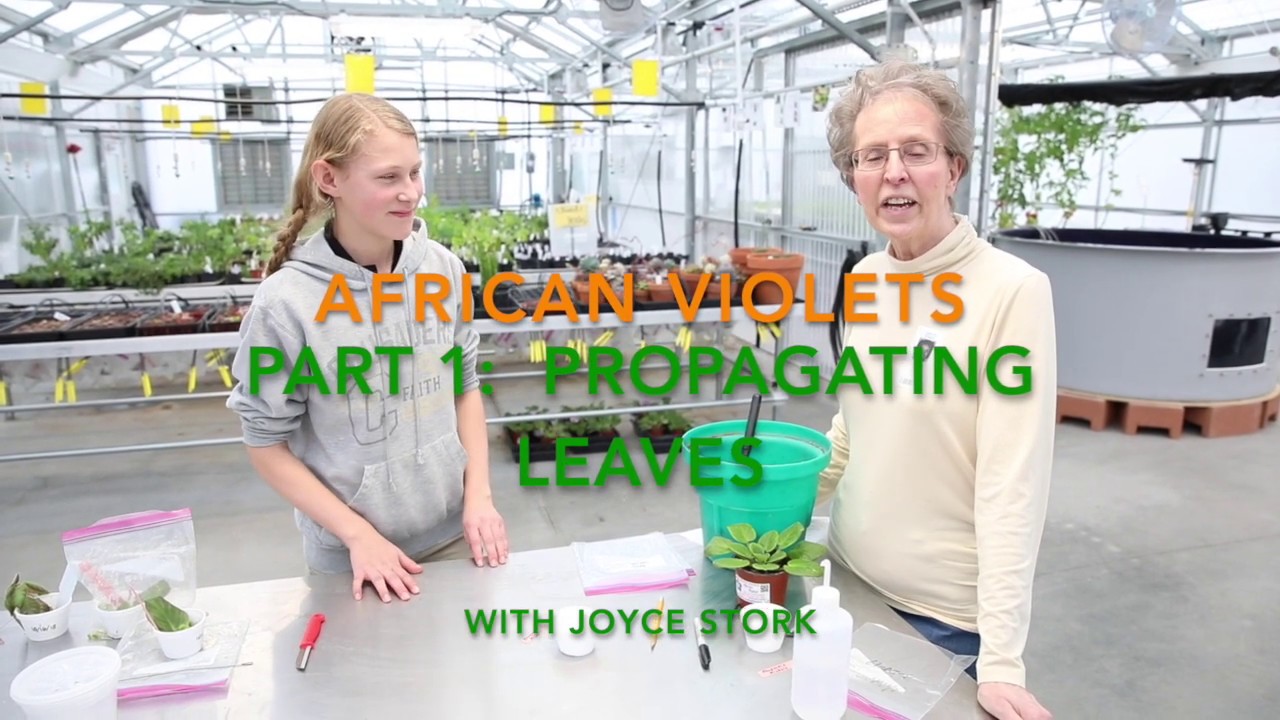
Propagating Leaves

Part One of Propagation with Joyce and Heidi

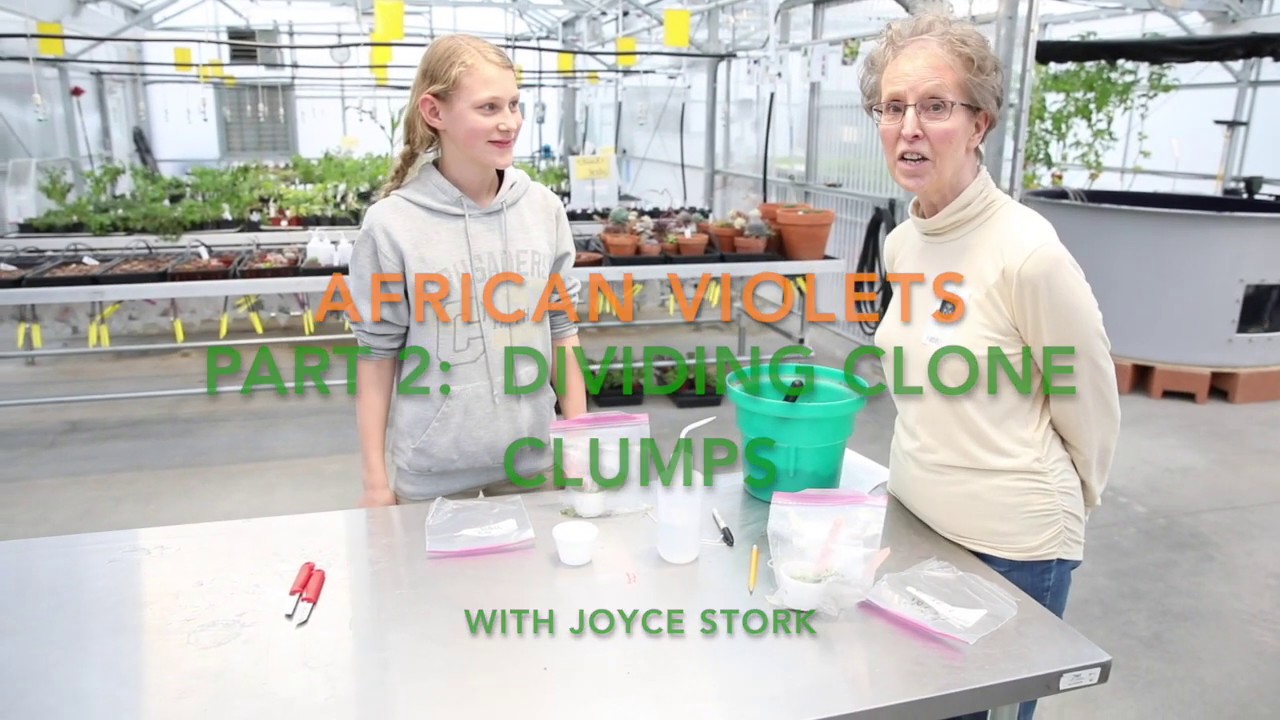
Dividing Clone Clumps

Part Two of Propagation with Joyce and Heidi

The Basics Are Not Just For Beginners

By Adrienne Rieck

Success with Gesneriads

By Dale Martens

Grooming Plants After a Show

By Anne Nicholas