In nature, the Saintpaulia species (wild African violets) grew in deep shade. Today’s hybrids often tolerate brighter light but most thrive in natural light on a windowsill. Violets getting adequate light will grow compactly and bloom more freely.
When the natural light is not adequate or available, it may be replaced by or supplemented with an alternate lighting system. Choosing a light system is not a simple task. Modern choices vary in efficiency, heat, and how the spectrum of light is displayed. The products offered are constantly changing and improving.
To guide your choice, we offer here the light systems in use by a variety of respected growers living in various areas of the United States.
“All African violet species and subspecies require moist and shaded conditions in their natural habitats. They often grow on steep rocks or in gullies, along the north side of shaded streams, or as undergrowth in dense sub-montane or montane rain forests.”
Dr. Jeff Smith Botanist at Ball State University
KURT JABLONSKI, FLORIDA
Uses T12 fluorescent light fixtures
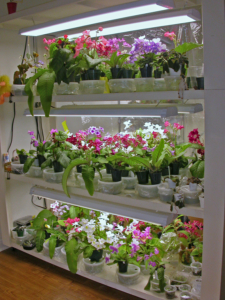
Kurt Jablonski’s show plants growing under T12 fluorescent light fixtures
One of the most important factors in growing beautiful plants is lighting. Without adequate light the plants cannot grow and bloom. In today’s world there have been many advancements in indoor growing including lighting. Personally, I like to experiment when growing African Violets but at the same time I also live by the motto “if it ain’t broke, don’t fix it,” which is why I have continued to use the older T12 shop lights in my growing regime.
They have proved successful over the years for many excellent growers for several reasons. First, they are affordable and fairly easy to find. You can buy the tubes and fixtures in most hardware stores as well as big box stores or on the internet. Second, the combination of using one warm white tube and cool white tube (my preference) makes the plants look more appealing to the eye. Third, by using one warm and one cool white tube you provide the full spectrum of light for your plants. Red light produces bloom while blue produces foliage. Fourth, for those that grow in cooler areas such as basements the fixtures emit more heat which can lead to faster and stronger growth.
In my apartment I have three and a half stands all using the T12 bulbs. The stands are all homemade except one which allows me to customize each shelf’s distance to properly grow specific plants. My standard practice is to have minis and semis 6-8” away from the lights (top of the plant to tube) and standards 10-12” away. All fixtures are connected to smart plugs allowing me to control light time with my smart devices and cell phone. I run the lights 8-9 hours a day and increase when on the show schedule. Keeping all lights the same is a simple method for me and I believe T12 lights have proven themselves over the years and continue to do so.
DALE MARTENS, ILLINOIS
Has mostly converted to LED fixtures
Dale Martens LED light fixtures
I’m seven-decades old. I’m thrifty (cheap). My plant stands are old; possibly one is 50 years old. I love my old, 4-shelf, Volkmann Brothers plant stand because the tubes are wide apart spreading out the light. I grow a couple of African violets, but mostly Streptocarpus and a variety of rhizomatous gesneriads.
When I grew under T-12 and T-8 fluorescent tube light, my eyes couldn’t take much more than 2 hours at a time in the plant room. I wanted LED lights, but did not want to change ballasts. We found that Philips Instantfit T-12 replacement LED tubes have worked continuously since November 2017. I have one “daylight” LED and one “warm white” LED tube and the plants have been happily growing and blooming. I grow the African violets under those tubes. The tubes are 48-inches long with 2100 lumens and 6500K. Philips has a web site showing ballast compatibility. With LED light, my eyes fine. I need to confess that I have one single shelf still with T-12 tubes for species gesneriads that need lower light, such as some primulinas. Keep in mind that the “ends” of T-12 tubes have the weakest light. LED light is evenly bright all the way to each end.
I also have an old, homemade stand and it began with two sets of T-12 shop lights, then graduated to T-8 lights and now has two LED shop lights per shelf. Yes, I said shop lights found on sale at the local hardware store. They have 3300 lumens, 4200K bright white light. There are no bulbs to replace. I got Sweepstakes in Horticulture at the 2019 Gesneriad Society convention, so these shop lights did very well for me. All my lights are on for 12 hours a day all year around.
Here’s the caution on LED lights: no heat. If you depend on heat from your plant stands in winter, that’s not happening with LED lights. Also fluorescent light spreads out. LED light is maximum directly over the plant, so if leaves are not directly under the LED light and you don’t turn your plants often, you’ll see the leaves twist to get light. After installing any new LED lights, have them on for only 9 hours and observe plant growth. If the leaves are reaching, increase the light by one hour at a time. It’s best to start at a lower time rather than risk tight growing centers.
STEPHEN COVOLO-HUDSON, CALIFORNIA
Explains how to adjust lights to get perfect results
Steve’s violets growing under lights
There are numerous types of lights, fixtures, and stands. This article will focus on duration and spacing, specifically under artificial light. I grow using fluorescent lights, but I feel this approach applies to other light sources, too. It can be a great jumping-off point if you are working with LED, also.
Duration is critical; how long should your lights be running.? All my stands run for eight hours or less, depending on the type of tubes used. So, a T12 tube emits less light than a T8 or T5. I explain it this way, the smaller the tube diameter, the great the surface, so more light emitted. So, you may need to back down the total hours your lights are on if you’re using T8 or T5; T5 tubes emit more light than a T8 bulb so that will require even less time.
How will you know you’ve hit that sweet spot? Let the plants tell you. They will grow flat as a board. Their leaf stems aren’t wrapping around the pot, and the crowns aren’t distorted or tight. I recommend starting at 8 hours, and then watching the plants for 3-4 weeks; mark your calendar for the start date, and if your plants are still growing tight and not laying flat, reduce the time by 5-10 minutes. You will then mark your calendar again, and do so until most of your plants are growing perfectly flat. That’s your sweet spot on time. Make a note of the number of hours for each stand(s.)
What’s the proper distance from the light source to the plants? Well, again, the plants will tell you. I keep my light fixtures that are moveable to the top. In some cases, that means the spacing from top to bottom that is 36” +. Here’s why not every cultivar has the same lighting needs; some require more light while others want less light. I solve this issue by first growing ever plant on the shelve; if they are all growing good, I do nothing. If some are growing spindle and open, I know they want more light. So, it enters using risers. I place plants that are asking for more light on upside-down plastic flower pot(s). This approach gives way to growing many cultivars perfectly on one stand, yet meeting their individual lighting needs. You may need to move some African violets from the end to the middle of the light tubes. It’s a process of learning and letting each cultivar tell you their needs. Once a plant has its home, it states there.
Growing under artificial lights can be rewarding. I find the most significant light duration issues and spacing from the light source to the hardest to figure out. So, start at 8 hours, adjust accordingly, and then adjust one more time for each cultivars individual’s requirements. Let the plants tell you, they always do.
DR. MINH BUI, MARYLAND
Grows with T5HO fluorescent bulbs and has done considerable research on lighting for African violets.
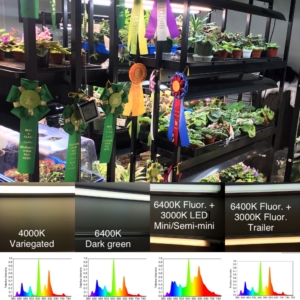
Dr. Minh Bui’s T5HO lights with graphs of light spectrum
A good starting point for a broad range of African violets (AV) is one 5000K T5HO fluorescent light bulb placed above the AVs to achieve a range of 3000-3500 Lux for standards, and 4500-5000 Lux (two bulbs may be required) for mini’s and semi-mini’s.
Though I do not recommend distance between the AV’s crown and light bulb as an accurate measurement (due to the age and reduced intensity of fluorescent bulbs overtime), a distance between 6.5 (mature, full grown standard) and 10 inches (young, starter plant) from the top of the crown’s canopy is recommended. A daylength of 7 hours a day is a good starting point. After close observation, adjust with 30 minute increments as necessary. However, certain AVs -particularly some of those with large and dark green foliage- will respond well to a higher amount of blue from 6400K, while others -those with variegated foliage- will respond poorly overtime and undergo photo-bleaching. These variegated AVs may prefer a warmer 4000-5000K setup. Each AV will respond differently and the plant may need to be moved to several light setups, followed by a 2-4 weeks observation period to determine whether the growth pattern meets the grower’s satisfaction.
The transition from T5HO fluorescent to LED retrofit bulbs is seamless, and not much tweaking of daylength is required. A few AVs thrive under two T5HO LED bulbs, one 6400K and one 3000K -particularly mini’s, semi-mini’s, trailers, and a few standards. Others will do well under 6400K for most of the time until it starts reaching for additional red light, right before a bloom cycle. When I see this, I supplement with a 3000K bulb until the crown flattens (typically about 1-2 weeks).
Finally, there are variegated and light green foliage AVs that grow with a single 5000K bulb alone, or in a 5000K/4000K combo. Ten to twelve weeks before show, I supplement the setup with one 3000K (higher red) bulb for blooms. In all possible lighting combinations, AVs will always have at least one, but no more than two bulbs (always in combination, never the same K temperature -i.e. two 5000K bulbs on the same shelf) at any time.
SANDRA SKALSKI, NEW JERSEY
Uses a combination of both fluorescent and LED
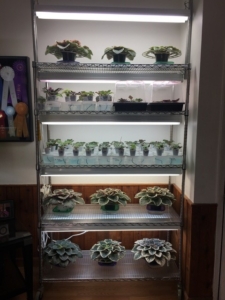
My main growing area is in an unfinished area of my basement. One of my challenges is keeping the area warm enough, so I rely on T12 fluorescent bulbs to provide extra warmth when the heater is not running. I use one cool white (5500K-6500K) and one warm white (3500K) bulb in each fixture. I change one bulb in each fixture every year, so all the bulbs are less than two years old. I run the lights for 10 hours per day (on a timer), as there is no natural light in the area.
The lights are about 10-12 inches above the standard plants and 6-8 inches above miniature plants. Trailers are around 8-9 inches below the lights. I try to keep one type of plant on each shelf and will move plants around if they seem to prefer more or less light. Plants with lighter green leaves are usually toward the ends of the shelves. The best-growing plants always get the choice spots on the shelf.
I’ve recently tried LED lights and I like the results, especially for plants with green leaves. One shelf has cool white LED strip lights (4 rows), and another shelf has warm white and cool white T8 bulbs. Although LEDs don’t give off the heat I need, the plants growing under the LED lights appear to have deeper green leaves and brighter color blossoms.
Karin Peters, Texas
Loves her dimmable LED setup
More and more growers are saying goodbye to their fluorescent lights in exchange for the convenience of LED’s. LED lights use less electricity, last longer, and are more cost effective. They also use substantially less heat making them safer, and I’ve noticed I don’t get water spots on leaves.
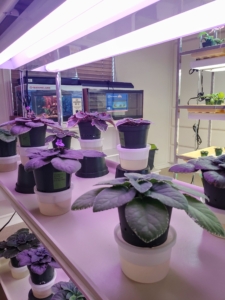
What I like most about my LED setup is that they are dimmable. This allows me to customize the amount of light for each shelf depending on their specific needs. The dimmers also allow the lights to be closer to the plants.
When I used fluorescent lighting on the same stand, I could only fit three shelves of plants as the plants had to be further away from the bulbs. But now with my dimmable lights, they require less distance between shelves, which freed up room to add another whole shelf, which meant more plants coming in the mail!

 Choosing the Best Light
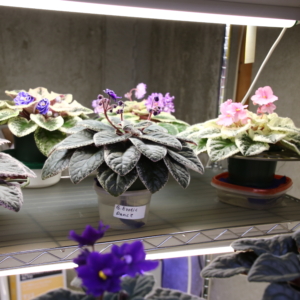 My main growing area is in an unfinished area of my basement. One of my challenges is keeping the area warm enough, so I rely on T12 fluorescent bulbs to provide extra warmth when the heater is not running. I use one cool white (5500K-6500K) and one warm white (3500K) bulb in each fixture. I change one bulb in each fixture every year, so all the bulbs are less than two years old. I run the lights for 10 hours per day (on a timer), as there is no natural light in the area.
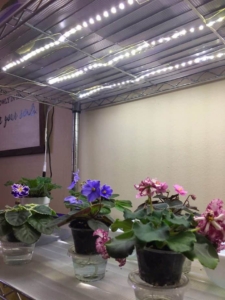 More and more growers are saying goodbye to their fluorescent lights in exchange for the convenience of LED’s. LED lights use less electricity, last longer, and are more cost effective. They also use substantially less heat making them safer, and I’ve noticed I don’t get water spots on leaves.